Wednesday, December 03, 2025

In-es-capable


The other day I was in a mall. If it gives you the impression that I hardly visit a mall, you are mistaken. In fact, we go there more times a month than is healthy either for our pocket or our health. No! I don’t go there for shopping. We go there on evenings when we are too tired watching the romcoms on TV. What are sitcoms, by the way? Yes. We will talk about my absolute ignorance about the actual meaning of the two later. But now about the mall.

So, it was a weekday. Let it be known that we never visit malls on weekends. By the way, we have realised that days in a week have ceased to have any meaning for us. We merely have time – time for the morning tea, breakfast, some more tea, lunch, afternoon tea, snack and dinner. We check the days only when we decide to go to the mall.

Well. It is like this. The other day, we were bored to the bone. So we decided that we should visit the mall. We got ready. And then realised that it was a Sunday. It should have struck us much before. Because on Sundays, our driver is on his weekly off. But we are old, and such lapses are increasingly becoming more and more common.

What are with the weekends! You see, it is amazing to see the malls swarming with people who are clueless about what to do with their time if they are let loose from their official tethers. That we go to the mall because we lack club memberships or work and don’t know what to do with our time is understandable. Because we are senile buffoons who ceased to be productive for society long back. But why do the malls overflow with the productive generation? To prove Mr N R Narayana Murthy right in a roundabout way?

Be that as it may, this is meant to be about us. So, that day we were bored to the bone. Am I repeating? That proves I am old. Anyway, so we decided to go to the mall to have coffee at the food court. We go to the food court for coffee, assuming that it is cheaper because the chairs are hard! (But am I right?)

The problem is, in this mall, the tea shops at the food court are right in front of the bars (did you know that they call them pubs these days?)! So by the time you finish your first cup, have taken a good look at how fashion struggles to stay profitable on bodies that are steps behind temporally, your belly aches for dinner.

Did you know the varieties of margaritas these bars have on offer!? Well by the time you taste your way through to the right mix, you are almost drunk. If you thought you would escape inebriation because you are a whiskey drinker, you are wrong. For they offer 2:1. If someone past 60 doesn’t feel dizzy with three pegs under the belt, then kudos to him/her. One good thing, though. The food we order invariably gets packed into doggy bags, and the next two dinners come free!

Pix credit:chatgpt

Sunday, November 09, 2025

I’d rather die annotated than live footnoted by bureaucracy


I
n this hypersensitive, garrulous-takes-all world, old-timers like me seem destined for premature extinction. Even a healthy senior, who might have lived well into her nineties, risks an early demise by seventy, particularly if she has the misfortune of being fond of reading.

Take me, for instance. I suppose a disclaimer is in order. Yes, when I left my job, I was a journalist — and, occasionally, reputable papers still publish my pieces. Having placed my disqualification on the table, let me carry on with this blog.

As I was saying — consider, for example, the current exercise called the “special intensive revision.” Had I not been told, I’d have quite forgotten the one in 2002 and the revisions it required. I suspect many would fall into my category. Were it not for this latest exercise, I, along with countless others, wouldn’t have bothered to recall it. Yes, I’m sure even then the exercise made headlines for various lapses. But did it truly warrant the rancour we’re witnessing now?

To be honest, I was worried. Ever since the Bihar fiasco, I’ve fretted over finding every little detail that this revision might demand. My parents-in-law were voters in New Alipore — but they are no longer around to confirm their particulars. The thought of failing to provide their details, and thus one day finding my wife in a detention centre thanks to an over-zealous administration acting in irrational haste, crossed my mind for a fleeting second! (For those wondering — yes, we sought help from friends, and now have the list that includes their names.)

If you think this is a bout of hyperventilation brought on by clinical paranoia, I wouldn’t blame you. But spare a thought for our leaders, who spew venom daily and inspire the mindless millions to do what they do best — act mindlessly.

And what do you suppose that does to the rest of us, the hapless? It breeds fear — fear of being on the wrong side of an over-zealous administration. Perhaps all of this is groundless. But try telling that to the man who took his life because his name, through some clerical lapse, was missing from the 2002 rolls — or to the pregnant woman languishing in a Bangladeshi prison, whose only “crime” was speaking Bengali in an Indian state. This is not to say we should turn a blind eye to illegal immigration. But surely we must ensure that no citizen is stripped of their rights in their own country. As I said, the fear is growing — fear of the heavy hand of an over-zealous state, stoked by leaders who thrive on rancour and division.

As for me, I’ll keep reading — it’s a dangerous habit in this world, I know. One never knows when a misplaced comma or a misinterpreted clause might get one blacklisted. Still, I’d rather die annotated than live footnoted by bureaucracy.

Saturday, April 05, 2025

Think you decide your day? Ask Didi or all those who may not be named


L
ying on the Fowler bed, I now have all the time in the world to reflect on life. For instance, yesterday felt like the day before, and the day before was like the previous day. It’s as if all the days are just repetitions of their previous ones. Don’t snigger. I know I am not saying anything new. If I were it would not have read so true. Neither would you have been tempted to snigger.

But just think about it. The earliest day of my life that I can remember was different from the current one. Of course, it was. I was a kid then, and now I’m a senior citizen and a parent to an adult person. But then, it was the same as it is now. I wake up in the morning, eat, bathe, go to school, then college, university, and eventually to the office. And now, I’m in the Fowler bed. The differences aren’t marked by actual differences; they’re marked by the almighty or whoever decided that tomorrow I would be older than today, and then the others who said after so many days from my birth, I should be at a place like school, college, and so on.

Pau Arenós, a Spanish journalist, wrote in his book “Las Pequeñas Alegrías” (the little joys) that he used to get pulled up by his mother for always living in the future! He writes, “No sé vivir el momento presente, sino el siguiente.” Roughly translated, it means, “I don’t know how to live in the present moment, as I live in the next (future).” Of course, it’s not a literal translation, but that’s what it means.

We all know it, don’t we? I didn’t need to quote him to prove that we think alike! But I did so because Anirban (Chattopadhyay) da gave it to me for reading while he came to visit.

Now that all the references are in place and the authenticity of the content has been verified, let me say what I set out to. As I was saying, the only thing that could truly mark a difference would be non-compliance! For example, if you drop out of a set course, like not going to college.

If you are looking for its veracity check out Trump’s way of doing stuff. I mean everything was cool. The economy was coming round and all of a sudden this man takes a contrarian turn, decides to raise tariff to bring the US boys home! That changed the day for all of us. May be differently to different person. But you see we didn’t have a hand in changing our daily experience. He did it for us! If it were not for him we would still be quite foggy about say what was different this day in January in such and such year.

Or, take for example, losing of jobs of thousands of teachers in one stroke! We didn’t do it. Yet our days, if they are different, have been so because someone else decided to screw our lives!

Therein lies the point. You see, you don’t change your day. You go to sleep, you wake up, you eat and go to the loo, you earn, you lose your job … hold on a second! No you don’t lose a job, they take it away from you thereby breaking the monotony of your life.

Are you foxed by reading it? Don’t. I wouldn’t have known this if on the 20th of February someone else decided to rule that I should fall and break my back! If it’s yet a haze ask the Didi or the Dada, he would explain everything to you. But don’t ever try to break the monotony yourself for yourself. It doesn’t work. Life has a different understanding of “different”.  Barriers look small but they decide whether you will cross it.

Wednesday, March 05, 2025

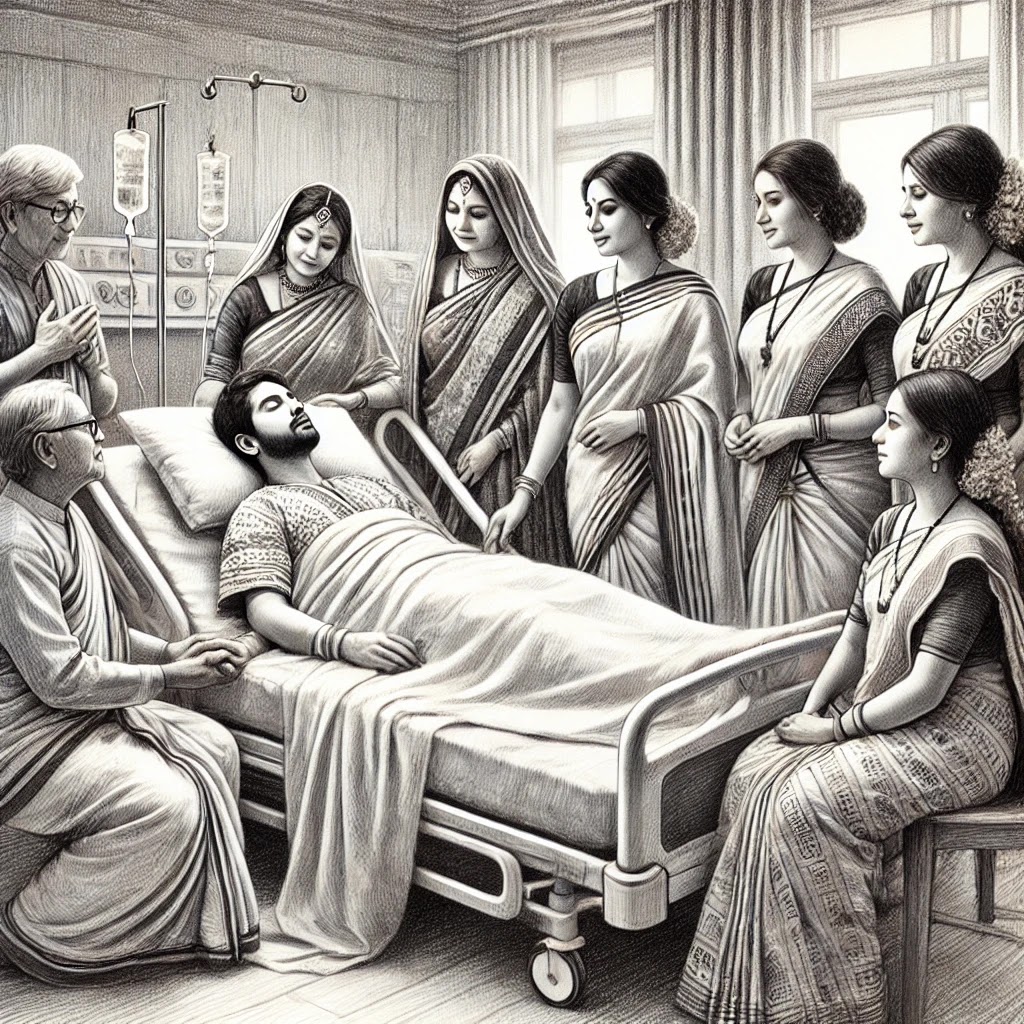
Slipping, Falling, and Finding Love in the Pain


As I slipped, I knew exactly what lay ahead for the next three months. But what I didn’t anticipate were the endless questions coming at me from all directions. Honestly, if I had known I was going to slip, I wouldn’t have been foolish enough not to prevent it! But would anyone listen?

— How did you fall? 

— I slipped on a wet staircase. (As you can see, I was trying to keep the questions to a minimum and allow myself more time to enjoy my pain.) 

— No! We mean, are you sure you slipped and didn’t fall because you blacked out? 

— (Damn! You’re wasting my time, guys.) I am absolutely certain this wasn’t caused by a blackout. I wasn’t drunk either. Now, please do something because I know I have a case of broken vertebrae—not just one, but multiple. 

— How do you know that? — (I was about to cry out in frustration.) Because this is the third time! And I know how it feels much better than you do! 

— How many stairs? 

— It didn’t give me time to count! Next time, I’ll try to fall in slow motion so I can get you an exact number!

As I lay in the emergency room, telling myself that this too would pass, the pain refused to let me forget.

For those uninitiated, I recently slipped on a rain-soaked staircase and fractured four vertebrae. It’s a record—apparently, breaking vertebrae more than once is a rarity. I’m writing this blog post because, despite my friends and family claiming my accident should be newsworthy, not a single news channel covered my story. Yet they show a cat getting run over as breaking news! Blame my luck.

I hadn’t actually planned to write about this. I had a different topic in mind. But life rarely follows our plans—just like my unexpected fall.

But, boy oh boy! Did I enjoy the attention? Maybe it’s age that makes you more aware of things beyond yourself. Like love.

Love is a strange thing. It’s felt the most when you’re confined or unwell. It works both ways—when you see someone you love in pain, your heart aches, and you instinctively reach out, wanting to share their suffering. And for the one lying helpless in bed, a simple touch becomes a renewal of life, a reassurance of existence. Love is a connection that, at times, mimics an umbilical cord. It transcends everything—it’s maternal, romantic, and the deepest bond we experience. And it is entirely gender-neutral. Love is the most precious gift we are blessed with.

That was a serious paragraph. But how true it is. Lying in the emergency room, all I longed for was a caring, loving touch. Isn’t it strange how your body’s very cells transmit your emotions? Even in the hands of professional caregivers, I could sense the empathy in some of them. It was a wonderful feeling—to be cared for, even in the absence of familiar, loving touches.

But when I first sat down to write, I had a completely different story in mind. Perhaps I wanted to talk about my interaction with DALL·E and how it reacted before generating the image you now see as the cover. But then, should I? I hear DALL·E is omnipresent on the internet. And who knows? Maybe it wouldn’t take kindly to my criticism and retaliate—just like the hospital stretcher-puller who was annoyed because he had a couple of dead bodies to transport after me. He didn’t care how he handled me. No, he didn’t have the touch of death. But he certainly lacked the touch of care!

Saturday, February 08, 2025

The Changing Face of the Kolkata Book Fair: Nostalgia, Commerce, and the Lost Space for Ideas


D
oes this happen only to me, or do others feel the same way? Standing in a rare quiet corner at the Kolkata International Book Fair, I found myself wondering—what if I hadn’t come? Has this visit become a ritual dictated by nostalgia rather than a true love for books? Has this annual journey turned into a pilgrimage, more out of habit than passion?

I still remember my first book fair. I was in school then, and back in those days, the fair was held at the Maidan. That vast, green expanse—often called the lungs of the city—would momentarily surrender itself to all kinds of artistic and intellectual pursuits beyond the commercial world. One such space was Mukto Mela.

If I remember correctly, Mukto Mela took place in the Maidan, opposite the Tata Centre. It was a vibrant space where one could witness Shakti Chattopadhyay, already a cult poet by the late sixties, composing poetry on the spot. Prakash Karmakar would be absorbed in his easel, while others engaged in singing, reciting, or dancing. Around this time, Sandipan Chattopadhyay introduced his Mini Books—each a mini volume dedicated to a writer or poet. Still in school, we would eagerly await each new edition. Even after half a century, I vividly recall the one featuring Shakti Chattopadhyay’s poems with illustrations by Prakash Karmakar. Soumitra Chattopadhyay could often be seen puffing on a cigarette, laughing at a joke—probably one cracked by Sunil Gangopadhyay.

The Book Fair itself was commercial but in a different way. Among the sprawling stalls of established publishers drawing large crowds, there was Boi Bazar, where one could find secondhand and slightly damaged books at massive discounts. That was our hunting ground. I still remember the thrill of discovering a 19th-century edition of Diwan-i-Makhfi—a collection of poetry by Zeb-un-Nissa, the celebrated poet-daughter of Aurangzeb. She spent most of her life imprisoned and died around 1702. The very fact that a 16-year-old could find and feel excited about a book like Zeb-un-Nissa in the fair speaks volumes about the kind of intellectual space it once was.

Why was I thinking about all this? The human mind is strange—it keeps making connections, even when you don’t intend to. The spot where I stood was on the outer ring of the fair. Just across the road was a barricaded area, strictly off-limits—no one was allowed to sit there and draw, sing, or recite. Some protested, but the authorities justified it by saying that the fair was for the buying and selling of books, nothing more.

A group of media students approached me for an interview. When I mentioned that I had been attending the fair since its inception, they were amazed. They asked me how book fairs of the past compared to those of today. I shared my thoughts but I failed to see any spark of excitement—or even regret—in their eyes.

It is unsettling to think that people are not reading as much anymore. But then I grew up in a para in North Kolkata where our home was the only one with books beyond the Panjika. Yet it was the period when excitement over books still ruled. Some claim that more books are now sold in Tier-2 cities than in Kolkata. Maybe. What is reassuring is that people are still reading. But the problem lies elsewhere. Those in the business of selling books seem to be suffocating the very space that nurtures the ideas behind them. Have we, as a society, developed an aversion to intellectual exchange? Is this fear of free thought stifling the emergence of new-age Shakti Chattopadhyays?

Or have we simply become worshippers of mediocrity? And don’t think twice about choking the space for creative thinking?

P.S. The books in the pix are a fraction of what I bought. They are just to illustrate.

Monday, December 09, 2024

Reconnecting with self: reading Harry Hobbs and Other Forgotten Lives


D
oes a city appear the same no matter where you view it from? Does it remain unchanged for someone born and raised within its borders? Or does it whisper the same stories to everyone? The answer to all these is likely a resounding "no."

I wasn’t born in Kolkata, but I grew up there. My memories are deeply tied to Baranagar in the 1960s — a place where the city ended, and a different world began. The boundary was Kashinath Dutta Road. On its southern side lay the "urban," and on our northern side, the "mofussil" began. Their taps gushed water; we drew ours from wells. There, visiting a neighbor required permission; here, it was as fluid as crossing a doorway. Perhaps these are mere impressions of a child, but impressions are as real as reality when it comes to memory. As I said, a city doesn’t speak in the same voice to everyone or remain the same across time.

I vividly recall wandering through the winding lanes that led to the Ganga. Those streets felt like passages through history. The Dutch Kuthi — a house that boldly announced its colonial lineage — stood as a silent witness to our daily adventures. The adjacent Kuthi Ghat hummed with life as boats carrying "khod" (straw) and earthenware rings for well-fortification anchored there. We, as children, would steal small bundles of straw to make "neda" for dole (Holi). The burnt ash from the neda had a special role in the colorful mischief of dole. Adults watched with indulgent smiles, and even the police, stationed at the old colonial-style thana overlooking the ghat, watched us with amused detachment. They must have done the same as children. Today, however, such antics would probably invite POCSO charges, a stark reminder of how much the world has changed.

Do children still do this today? Probably not. And honestly, we never asked about the origins of the Dutch Kuthi. It was just there — a part of us, but not of us. I have no idea if the building still stands. If it does, I doubt it speaks the same language it did to us. It can't. The boats are gone, the thana has moved, and the culture that enveloped it all has become a memory. As Ramakrishna, who once walked these very streets and enjoyed telebhaja from the same shop like us, has now been placed within the glass case of history.

Devasis Chattopadhyay's Harry Hobbs of Kolkata and Other Forgotten Lives stirred all these thoughts in me. Reading about the ship Tuscany bringing ice from America to Kolkata in the 19th century — and the flurry of excitement it caused among the sahibs — strangely reminded me of those stolen straw bundles and neda fires. The parallels between the colonial era and my own childhood experiences weren’t logical, but they were deeply felt.

To claim that we can relate to the world of 18th- and 19th-century Bengal as if it were our own would be a stretch. But reading about Shakespeare’s kin residing in Kolkata — and learning about their relationships, exploits, and legacy — evokes a certain intimacy with that world. Facts on their own remain cold and distant, but Chattopadhyay imbues them with warmth and life, creating an emotional bridge to a time long past.

And that, to me, is the book’s greatest triumph. It connects me to my city. It reminds me of a social media post I read recently. A visitor from Delhi remarked, "I have fallen in love with Kolkata. Unlike my city, Delhi, which I love, that asks me what I can give to it, Kolkata merely gives unasked." The observation felt profound. But is Kolkata one city? No. Each of its streets carries its own identity, its own micro-culture. There is a broad cultural tapestry that defines Kolkata as a whole, but its streets and neighborhoods tell distinctly personal stories.

Take the babus of Kolkata. While their families lived in the main city, their revelries took them to the North. Imagine Michael Madhusudan Dutta, that celebrated poet, singing Dave Carson’s Bengali Babu at home. For context, Dave Carson was a popular comic figure, preserved in books most of us haven’t read but brought vividly to life by Chattopadhyay. Without Chattopadhyay’s storytelling, Carson’s spoofs of the Bengali babus might have been little more than a historical footnote. But by linking it to Madhusudan Dutta and how he loved to sing Bengali Babu´ Chattopadhyay breathes life into a cultural relic, making it feel as tangible as the Dutch Kuthi did to me as a child.

And this is where Chattopadhyay's magic lies. After reading Harry Hobbs of Kolkata and Other Forgotten Lives, you will no longer walk past old buildings the same way. They will speak to you. Their silence will crack. Just as the Dutch Kuthi once whispered secrets to a child in the sixties, so too will the forgotten lives in Chattopadhyay's book whisper to you.

Kudos, Mr. Chattopadhyay, for reminding us that no two people experience a city in the same way, and no two eras view its streets with the same eyes. You’ve made us hear voices long buried, and perhaps, if we listen closely, they will still have something to say.

Published by Paper Missile: An imprint of Niyogi Books

Sunday, June 16, 2024

A Bong will always be a Bong


I have known Rajib and of him ever since he started his professional life as a journalist and then of him when he decided to say adieu to his profession as a scribe and instead preferred to sit opposite the table as a senior communication professional.

So I thought. Then came covid and another hue from his plume was revealed! And Mi Dios mío! How! This lad whom I knew as a wordsmith in reality turned out to be a skilled connector of dots as well! His preferred alphabet was not the one that divines words but strokes that create images. Images of everyday life. The ones that define us and we think so little of them. In his sketches, they come alive and remind us how precious they are.

Let us take a step back to the covid and quarantine days. It was a global lockdown. The whole world looked so bleak. Death was apparently the only news that merited a place in the headlines and news blogs were actually the recounters of the spread of covid. During that time many decided to share their passions with their friends and talents were discovered. And Rajiv was no exception. Suddenly, his LinkedIn posts mutated into sketches depicting his reflections on those bleak everyday life yet managed to extract a smile. And his sagacious corporate utterances took a back seat. Now, he has taken another step forward with his newly revealed skill set.

No. He is no Mario Miranda. At least not yet. But his book Bangaliyana skillfully marries his sketches with deft stitching of words to present us with an oeuvre of his emotions about being a Bengali yet not being one. Because he missed a few important stuff as he was a prabashi (expat Bengali)! In fact, the whole story in his book is founded upon those missed steps and his wonderment about them.

This book is straight out of his heart. So truly that my wife, brought up in Delhi, grabbed the book as Amazon delivered it and read through it in one sitting! I could see her smiling as she raced through the book. It wasn’t difficult for her to relate to those frustrations about saying something that was a statement and finding the cousins laughing. The realization that her pronunciations marked her out as a prabashi still haunts her despite having spent 37 years with a pure Bengali in khaas Kolkata! And Rajib endorses her angst.

This book is not just a prabashi talking to another prabashi. This book will also resonate with a pure-bred bong as it did with me. It keeps reminding you that a tiger never changes its stripes. Or, better still, a bong will always be bong – macher jhol bhaat or no maacher jhol bhaat! Point to note, the spelling of his name gives him away as a prabashi. He spells his name as Rajiv and not Rajib as a Kolkata-bred Bong like me might. 

A disclaimer. He was the one I asked to conceptualise and execute the logo of Content Crankers and he, as expected, hit the nail on its head. There was no space for disagreement.

Tuesday, May 21, 2024

Meaning of Empathy?


I was in a profession that made a regular lifestyle a challenge. Dinner by ten was considered irregular and bed before 2 am was an absurdity. Post sixty that lifestyle is now extracting its price. So I am now a regular visitor to physicians dissecting my past life and wishing more patients like me. 

As they say, que sera sera, or, as you sow you reap, but then those OPDs (Outpatient departments) also provide valuable life lessons.

Now let us assume that you are a nobody and you are ill. And you have been told that Dr X is the best. He does OPD at the hospital in your neighbourhood. So you don’t go to the hospital for treatment as such, but you go to the hospital to get treated by Dr. X.

Well. Now comes the part we all dread. Of being treated like dirt. The receptionist doesn’t care to look at your face even:

— Name?

— Doc?

— Why?

— 1500 rupees.

— Go and sit at the doc’s OPD reception

The damn hospital is big and you don’t know where Dr X sits. You try to ask that and face a royal snub. The guy standing next to you in the queue looks at you as if you have committed a crime! In a sense you have. You have stolen a few impatient seconds from his time.

But you are past sixty now. Whatever you were in your past life, with your chair gone there has been a big dent in your confidence level. And you cannot bear down on the receptionist enough to elicit the answer.

So you turn around and try to find someone who could guide you to the destination. You probably find a kind sweeper or someone ‘lowly’ enough to understand the ‘nobody’s’ (i.e. your) predicament and get guided to that specific waiting area which also has a receptionist.

You are a respecter of process. You are ready to wait your turn in the queue but you have not been told your serial number. So you approach the receptionist and she tells you curtly

— You will know when your turn comes

She goes back to whatever she was doing. By the time you find a seat in the waiting room your confidence is completely shattered. The PA system comes to life. A name is called and you find the guy who was behind you walking proudly in. Yes as he passed you by you must have felt his snigger at the lowly other patients! 

So you gather enough courage and walk up to the receptionist to point that out and she replies with disgust

— I told you you would know when your turn comes!

At that point perhaps a big gun in the hospital admin recognises you, comes over and shakes your hand. You are saved.  You are back to being that man who matters!  And the same receptionist who was scowling at you minutes back is now repulsively obsequious. 

The patient who was ahead of you in the queue and is clearly frail and needs to be attended to immediately stays behind!


Tuesday, February 13, 2024

He doesn't write because he cannot


Getting reminded of my inability to write is not a pleasant feeling. Especially when I have spent all of my professional life as a journalist!

If I am seeing a smirk and a desperation to hide the derision I wouldn’t blame you. Or if it’s a pity I wouldn’t fight that either. Because one cannot hide from the truth forever. So the earlier the better.

Earlier! Yes, I know. It makes me dumb. Anyone who takes four decades of one’s adult life to realise that one has been deluding oneself and steadfastly ignoring the reality has to be conceited beyond doubt.

I buy books throughout the year. Not that I read all of them. But like many others, I like to live surrounded by books — dust, and my wife’s disapproval notwithstanding. And I also buy books written by my friends.

For example, this year at the Kolkata International Book Fair, the first book that I picked up was the book on Dipankar Dasguta’s book on food. For want of a better description I am leaving it at that. I will definitely write about his book in this space some other day.

I have known Dipankar for decades. He started his professional life as a journalist with Bartaman. And then he moved on to the United States Information Service. Younger to me by a couple of years he has retired. Together with his wife he roams the districts of West Bengal and shares his experience of tasting food on Facebook. Incidentally, his wife, Krishna Sarbari, has also written a book and yes, I have bought her book as well.

And there are others. And many young publishers are bringing out commendable titles being written by them. So there was this young publisher I was chatting with. Stupid me in the flow of conversations had to say, “Bengalis hardly write about their professional experience!” He instantly latched onto this and turned it around against me. “Who is saying? You are said to be the first in Bengali media to build a bureau specialising in business. Yet, you haven’t written anything about it!”

And all of a sudden the reality dawned. I didn’t write because, perhaps, I couldn’t write. Dipankar wrote because he can! Simple. He didn’t buy it. But it is what it is.

Friday, July 21, 2023

Invest in your well-being. Buy protection through Mediclaim.


Nomoshkar, welcome to Monmoney, presented by Content Crankers. Today’s episode is about medical insurance. But before we proceed, please take a look at the opening screen.

Suparna Pathak: I am Suparna Pathak, with me is Investment advisor Saibal Biswas. Our questions to Saibal today are about Medical Insurance. Medical insurance is pretty complicated. People don’t understand how much coverage is needed, what are riders? Many complain that with a coverage of less than Rs 5 lakh, am unable to get admission in any nursing home, as only 1 per cent bed charge is allowable on the entire amount… can you please walk us through the world of medical insurance.

Saibal Biswas: We hardly study medical insurance and mostly buy it out of compulsion. How much to insure? We don’t know and follow wild suggestions. Let me start with a little fact here – the cost of education and medical insurance attracts the highest inflation rates, running almost in double digits. This means that our medical expenses are going up by the day

Suparna Pathak: it is about 14 per cent on average over the last five years…

Saibal Biswas: now if you add compound rate on that, you can imagine where it is headed. What I feel is that we must consider Mediclaim as the priority. Because we don’t know how high medical expenses will be in the days to come. There are many families who have become impoverished in trying to meet medical needs. I feel that we must give more attention to medical insurance, and increase the coverage amount.

One good thing is that suppose you take a policy of Rs 10 lakhs and there is no claim, then the coverage amount gets automatically increased, even doubling over time. This is a good thing.

Secondly, as you are mentioning, and we often overlook these, there are different limits, Like a 1 per cent limit on room rents, or a 2 per cent limit on ICU’s, in which cases you have to pay out of pocket. However, there are policies where these limits are waived, or you can take a rider.

Suparna Pathak: And perhaps they are not very expensive either…

Saibal Biswas: yes, you have to pay a little extra premium. In cases of medical emergencies, we reach out to the nearest facility where we feel the best treatment will be made available. Now at that point in time, perhaps the low-cost rooms may not be available and one has to shell out the extra amount. What I feel is that we must be careful, we have to see the features of the policies. Suppose in one particular year, the policy ceiling gets extinguished, can we still access the policy in that year? There are many small riders, add-on’s that we must check out.

Suparna Pathak: You are saying that I can take a policy for Rs 5 lakhs and by spending a little extra, buy some riders, like a room rent allowance. As we have seen during the Covid a huge amount of consumables were used, which are mostly not covered …

Saibal Biswas: exactly. Such riders can be bought. One can even buy riders where one gets cash benefits, where every day spent in the hospital entitles one to a cash benefit, provided one has opted for that rider. Similar is the case with maternity benefits. Critical illness – if one takes such a rider one is provided with a lump sum immediately. We all know how expensive the treatment of critical illnesses like a kidney ailment or major cancer is … a part of which can be addressed with riders.

I feel everyone must pay attention to medical insurance and increase the amount of coverage. Many people think that the office pays for medical insurance. But what happens after you retire? Perhaps you will not be able to access anything when you need it

Suparna Pathak: Besides, after the age of 60, new policies cannot be started vSaibal Biswas: my take on the subject is that even if the office pays for the insurance one should take additional coverage and perhaps even increase it after retirement. Everyone must look at the riders and carefully study what is being offered by which insurer to arrive at the best policy for the self, for health is something that cannot be compromised.

Perhaps we should do a full episode on medical insurance at a later date.

Suparna Pathak: We will return with a full episode on medical insurance for we seldom appreciate the value of teeth while we have them. It will not be out of context to state here that the cost of dental care is also going through the roof and you can also consider getting dental care under your medical insurance umbrella.

Keep watching Mon Money, Check out the description box to get our contact addresses, keep sending in your queries, and to see the written text of our discussions. Like, Subscribe and press the bell icon to receive notifications about our latest episodes. Nomoshkar.

Saibal Biswas: keep sending in your questions. Perhaps they will lead us to areas hitherto untravelled. Stay with us. Thank You.

Episode takeaway: Mediclaim is a Must. Another Must is reading the fine print.

Friday, June 30, 2023

Who the hell needs an advisor? I know everything.


Namoshkar, welcome to Mon Money presented by Content Crankers. We are back with a new episode, but before we move on, let us take a look at our opening screen.

What we will discuss today is a common question. For example, Utpal babu from Burdwan has asked us why we need to go to an advisor. What more do they know about my investment needs? Well, he may not have asked it in so many words, but that is the crux. I am Suparna Pathak, and with me is investment advisor Saibal Biswas – let us put the question before him.

Saibal Biswas: We may stand in front of a mirror and lapse into a monologue, but do we have all the right answers to our questions? We don’t. That is why we need mentors, colleagues, and subordinates… we feel that it is always prudent to get a second opinion. Finance is no exception. And for getting our decisions evaluated, it always makes sense to approach someone who has domain knowledge, someone who has studied the subject. This is a very basic rationale behind the importance of an advisor.

Now look at it this way. Suppose your age is X and mine is Y, our risk-taking ability may not be the same. Our goals may be different. Our investing ability may be different. Even, our financial outlook may be different.

Suparna Pathak: even if our ages are the same, our investing abilities may differ…

Saibal Biswas: Exactly. We tend to box things in. We tend to say that the risk-taking ability of a particular 25-year-old boy will be similar to that of another 25-year-old. But it may not be the case. What I am trying to convey is that everyone is unique. Their risk appetite and their ability to take risk is also unique. Their goals are unique and the roads to approach those goals will also be different. Who will decide on these roads? Who will analyse the risks? Who will choose the ways of approaching these goals? How are you going to achieve these goas and how will you continuously review your performance – this is where you need an advisor.

Suparna Pathak: an advisor is thus in effect like a doctor? Someone who identifies the pulse of the patient to identify the ailment. Now the question is, what is the pulse that you, investment advisors, look for?

Saibal Biswas: Every person’s need for investment is goal or target-dependent. Suppose one is unmarried. Then the question of saving for one’s children’s education does not arise. Even one’s need for insuring one’s life is redundant. As everyone is unique, we have to identify the needs through discussion. The person has to explain his or her needs, what is it that they seek to invest for and identify the goals. And based on that we draw out the charts and chalk out the routes.

Suparna Pathak: What kind of information do you need to arrive at such decisions?

Saibal Biswas: For understanding the risk we run a questionnaire. Where we try to understand how the person behaves when he or she is faced with certain circumstances. This is a part of behavioural economics – we believe that someone who gets easily scared when the market falls should avoid being exposed to equity. Similarly, there are others who may feel that they are not risk averse, people who want to take risks to earn more. They may be provided with higher exposure to equity. From the questionnaire, we identify the ability and willingness to take risks. Suppose we break it down to three categories – conservatives who do not want to take any risks, neutral who can take some amount to risk and aggressive who want the maximum risks to maximise their returns. Based on this we can fit a number to it, and then decide which asset class will best meet these goals.

Suparna Pathak: You mentioned a number. You have talked of this number in past episodes as well, what exactly is this number?

Saibal Biswas: Let me give an example. Suppose one’ son’s current age is 10. At 18, suppose he will go to study engineering. Now suppose the cost of studying engineering today is Rs 20 lakhs. Now in eight years’ time, because of inflation, that Rs 20 lakhs will become Rs 30 lakhs. So, one has created a number – that on a particular year, one will need Rs 30 lakhs. How this figure will be reached is the purpose of both the customer and the advisor helping one.

Suparna Pathak: This means that an investment advisor is the doctor of our finances. Their job is to understand our ability to take risks. Just as should not hide anything from the doctors, similarly one should not hide any material facts from the investment advisors. Their job is to go through your earning ability, spending habits and arrive at your ability to take risks. That is why we suggest that in this complex world to invest right, identify the right investment advisor first.

Stay tuned will we come up with more investment and savings-related questions answers and commentaries in the coming episodes. Post your questions in the description box. Visit our website to access our blog where this and more discussions will be uploaded. Saibal Biswas: Press the bell button for notifications. Write in your comments. Stay with us. Thank you.

Takeaway:

An investment Advisor is your financial physician. He helps you remain in the pink of financial health while helping you achieve your investment goals.

Thursday, June 22, 2023

Balance risk, choose the right fund


Suparna Pathak: Welcome to another episode of Mon Money. I am Suparna Pathak and with me is investment advisor Saibal Biswas. Before we move forward, let us take a quick look at our opening screen.

Suparna Pathak: Saibal, everyone invests in Mutual Funds. More or less, everyone is of the opinion that investing in mutual funds will generate good returns. However, which Mutual Fund? Why Mutual Funds? Answers to these questions are still largely not known universally. If you tell us about Mutual funds – why we should invest in Mutual Funds, in what kind of funds…

Saibal Biswas: let me start by defining a Mutual Fund. To put it simply, a Mutual Fund is a vehicle that can carry many things simultaneously. A Mutual Fund is where we have collected different types of investments on the one hand while we have collected many investors on the other. They have all put their monies in the common basket and when the basket grows, the benefit is shared by them. This may be an oversimplification of things, but this is it.

What a Mutual Fund offers is professional management. These are professionally managed by Asset Management Companies. Naturally, if one were to manage the fund on one’s own, this kind of research, this professionalism would have lacked, or even the kind of funds available for investment would not have been there. For an individual, it would not have been possible to compile so many different kinds of investments.

The second advantage is risk diversification. If one were to invest in any one class of asset, it may lead to a disproportionately high amount of risk, but a Mutual Fund allows one to spread the risk evenly.

The third point is that one can invest in a Mutual Fund even with a low corpus fund which may be as low as Rs 500 or 1000. There may be many economically challenged people who may want to invest but are unable to because of the lack of funds. The Mutual Fund offers them a route.

Liquidity. Mutual funds are largely liquid. Some allow the withdrawal of funds within a day. In equity-based funds, investments can be withdrawn within two days. Basically, they are very liquid.

Because of the numbers involved – from investors to investments, to corpus funds – the cost of creating the basket also goes down.

So, a Mutual Fund offers a basket, at a decent cost, that is professionally managed and monitored by SEBI that also offers tax savings in cases. Overall, it is a great basket.

That is not to say that all funds were born equal. Debt funds, which are based on fixed assets, offer low returns while being exposed to lower amounts of risks. While equity funds offer higher returns with higher risks. There are also mixed baskets where debt and equity funds are mixed to create a Balanced Fund. This is to say that there are different categories of Mutual funds and one has to choose one according to one’s requirement.

Suparna Pathak: What you are essentially saying is that if one had, say Rs 100, one could have bought into a certain class of investment. Now if one invests the same amount with many others in a Mutual Fund, then professionals will invest the collected amount on behalf of everyone, freeing one of the worries relating to the why, when, and where of investing. The crux of the matter is that what one cannot do

individually, one can achieve through a Mutual Fund. Secondly, with a very small corpus fund, one can invest in a well-diversified basket – in bonds, in equity, perhaps even in real estate. The spreading of risks is also taken care of in a Mutual Fund

But are all Mutual Funds good? Towards which one should I turn?

Saibal Biswas: Risk. The choice of a mutual fund will depend upon one’s risk appetite. It will also depend upon one’s goals. For example, the goals that are on the longer term, allow one to tread a slightly riskier path. We have discussed in the past how, if equity is given adequate time, its riskiness goes gown increasing its returns. That is if one has long-term goals, one can consider equity investment as the chosen weapon.

Now suppose one has a short-term goal and wants to buy a car in two-year’s time. If the funds are deployed in the equity market, and it falls, that will be catastrophic. There is condemnation all round. But the fact remains, it was due to the wrong identification of the goal and the investment class. Here the identification and marrying of the right goal to the right investment is of paramount importance. That is why we say that for short-term goals, invest in fixed classes – they may be fixed deposits, mutual funds, bonds and the like, but for meeting long-term goals, use equity. The selection must be very precise and clear.

Suparna Pathak: many people pick up funds as it is said that the particular fund has posted the highest return. Should one make this the only factor or consider other things before choosing a mutual find?

Saibal Biswas: The return that is high today, may become low the next year if such returns were the result of high risk. What we look for is the consistency of returns. What kind of an outlook the Fund Manager has, the investment philosophy as it were. The Fund may follow a growth route or a value route but it should also accord some amount of safety. Otherwise, why will one take the Mutual Fund route?

Highest return should not be the consideration. It is good if such figures are posted, but what we look for is the consistency of returns with adequate safety.

Suparna Pathak: Investments, like relationships, is also about stability.

To sum up, what Saibal Biswas has said today is that one should invest in mutual funds, for even with a small saving, one can access all opportunities of investing in different parts of the market through them. He has also said that in order to identify the right fund to invest in, look for one that is stable, like peace is, in relationships. It is even better if you discuss with an expert advisor to seek out the right fund for yourself.

In the next episode we will see how investment advisors go about their jobs, how they analyze risks and on what they base their advice.

Saibal Biswas: keep watching.

Takeaway:

Identifying the right Mutual Fund is the trick in the game of investment. Consulting an advisor is advisable.

Thursday, June 15, 2023

If it were not for books


I
wrote this a few years back in response to Prof Ayan Banerjee’s call to list 10 of my favourite books. If floated up on Facebook again And frankly, I was stumped. And as I kept reading this old post I thought of curating this as my blog as well.
 
Now, It's not as if I am not used to requests but requests of such intellectual proportion have seriously not been a regular occurrence. So, I was tempted to start with Swapan Kumar just for the play but it wouldn't have been right. So here I go. 
 
At an age when kids go out and enjoy a game, I was given a space of a few metres of a blind lane and access to the district library in Baranagar Ramkrishna Mission. Beyond that was a world full of violence, police raids and conflicts of sorts that were believed to have a corrupting influence on a young mind, and, of course, the real physical danger of stopping a stray bullet. 

 I had learning difficulties. Coming from a family where scholastic achievements and literary fame came easily, I was a skeleton in the cupboard as it were. But that lack of recognition was made up many times over by the books in that library and my father's collection. 

 Well as I said I had a middling intellect and an eager tongue. And I was fairing poorly in school. This was the time when I stumbled upon জীবন স্মৃতি by Rabindranath. What I am today is primarily because of that book, elementary physics, Euclidean geometry and Asimov.
Ayan Banerjee stay on. 

 I am curious to know how many of you reading this piece still remember the intro that Tagore wrote the way only he could. He writes that life paints pictures on the easel of memory and the facts blur. So what he was going to write shouldn't be checked for historical veracity. It struck a chord in my young mind. 

And then came Euclid. And somehow even my middling intellect latched on to the importance of an intro while communicating something. I realised that even literary efforts needed a structure as did academic articulation. 

While for years my mother and my teachers were trying to drum in an academic sense into my dyslectic mind, Tagore and Euclid together achieved the feat effortlessly. 

And then came elementary physics and the concept of relative motion. While for a lot like you, the difference between Newton and Einstein may have opened the gate for figuring out the intricacies of the physical world, to me it came as a justification for what I was -- a being with a middling intellect. What I was, I was. 

What I am today is what I am -- the product of a complex journey, a being defined by its course etched in my memory, a person defined by others from their relative perspective. Wait for Asimov. As is required I invite my cousin Ananyo Bhattacharya to join me in this journey. 
 
Illustration done by Dall-E

Wednesday, June 14, 2023

You can now invest in foreign stocks and reap the benefits. But stay informed about the risks too

Suparna Pathak: Namoshkar. Welcome to Mon Money produced by Content Crakners. I am Suparna Pathak, and with me is Saibal Biswas, an Investment Consultant. In this episode, we will be discussing savings and investments. Before that, a quick look at our starting screen.

Saibal, Ramprasad babu from Medinipur has sent us a question. I am not disclosing his actual name as he has some reservations about it. He wants to know how he can invest overseas.

Saibal Biswas: There are two ways of investing abroad. One, you can buy shares overseas directly upto a certain limit as set by the government. This is called the LSR Route, which is $ 250,000, a substantial amount. There are many international funds as well, funds that invest in stocks overseas. One can invest in these as well through Mutual Funds. Ramprasad babu can either invest directly, or take the Mutual Fund route and invest through them in the stocks they choose.


Suparna Pathak: But why will he do this? What is his benefit? What kind of risk or benefit can he expect?

Saibal Biswas: Well, when we are investing in India, we are investing in only one particular economy, depending upon one particular geography. If anything untoward were to happen to our economy, my market may fall. In such a scenario if I invest abroad, in a different economy, it may so happen that their market may not fall … this is a diversification process. The second point is that of currencies. Say for example the US Dollar is now quoting at Rs 80 which may go up to Rs 85 tomorrow: in such a case not only will I get the benefit accruing to my investment, but will also get the benefit of currency appreciation. This is an extension of the dictum of spreading your investments – previously we used to advise people to spread their savings across debt, equity etc, today we are saying do that, but also spread it to different geographies, over different currencies. Invest in such types of stocks that are not available here.   

Suparna Pathak: All this while we had restricted our discussion to the Indian economy. Now what you are saying is that it is possible to spread our risks further by investing abroad. Perhaps, if our market falls and theirs does not, then the investment would be safeguarded. The second thing that you are saying, and let me understand this, is that if I invest in a hundred dollars at Rs 80 a dollar my investment will be Rs 8000. Then, suppose, even if other things remain the same and the Dollar rate goes up to Rs 83, I will still gain by Rs 300. So, I am getting two advantages, one of investing in overseas markets to take advantage of their dynamism, and two, the advantage of currency exchange differentials.

In this context, what do you mean by terms like averaging?  

Saibal Biswas: Averaging means, suppose I buy something at a certain price and the price falls. Then if I buy more of it at a lower price, then the cost of my entire holding will go down. To cite an example, if I buy some stocks at Rs 80 and the price goes down to 60 and I buy more, then my cost of holding will come down to under Rs 80. 

Suparna Pathak: Perhaps if I then sell at Rs 75, I may even make a profit.

Saibal Biswas: exactly.

Suparna Pathak: This means if I were to sell at Rs 60 I would have lost, but since I bought more, and my average cost is reduced, I am still able to turn a profit.

Saibal Biswas: Let me go back to investing overseas and point out that there is a flip side to it too that everybody should be aware of. It is also possible that we invest in a geography that goes under … we must understand this risk. Or suppose we invest in a currency that starts to depreciate, for whatever reasons, this means that we have to do enough research to invest overseas. That is, it is not that anyone can go to any country and invest, I feel one needs someone, an advisor, who can act as a guide. So, investing overseas is not unidimensional, it has both sides of the coin…

Suparna Pathak: Ramprasad babu, are you hearing us? There are many hassles as well. It is not that by investing overseas one can access endless gains. The more you spread your risks, including in overseas markets, the character of your risk will also change. When you are investing abroad you will have to contend not only with the risk of your currency but also with geo-political risks, how different factors will affect its economic prospects will also have to be considered.  

What Saibal is saying is do invest. But take the advice of someone who knows before investing overseas. 

Today we have discussed about investing overseas and have seen that there are two advantages – one of gaining from the price fluctuations in their share market and two of gaining from currency exchange differentials. That is to say, even if their market remains constant and the value of Rupee depreciates, you will still be the gainer. On the flip side, the socio-economic-political status of the country you are investing in will have to be considered to assess your risk, which is why, you must seek advice.

Let us stop here today. Please like, share, and if you want to refer to this again, go to the description box where all the details are provided. Nomoshkar.

Saibal Biswas: Please share and like Ramprasad babu if you want to send us your questions feel free to send them to us.

Thank You.


Takeaway

Investing abroad offers multiple benefits, but beware, the risks are many too.


Friday, June 09, 2023

Time your equity investment


Suparna Pathak:
Namoshkaar. Welcome to Mon Money presented by Content Crankers. This discussion is about the intricacies of Savings, so subscribe and keep learning about the various facets of savings. I am Suparna Pathak, with me is Investment Advisor Saibal Biswas. Before taking our questions to him, let us take a quick look at our opening screen.
Saibal, we had promised our viewers that we will discuss about the stock market. Many people say many things about the stock markets. But the point that keeps recurring is that the more time one remains invested in the stock market, the more the return. The age of the investor is also relevant in the context. If you could tell us something about this.
Saibal Biswas: 
As an investment advisor we hold the view that the faster one enters the market, the lower becomes the risk. There is always risk in the share market, but if one remains invested in the market for a sufficiently long period of time then the risk is reduced. When one enters the share market at a young age, then the person gets a long time to remain in the market. Let us take an example – suppose one wants to buy a car worth Rs 20 lakhs after a period of seven years. This means that an investment of about Rs 12000 monthly in some Systematic Investment Plan of some Equity Fund will ensure such a sum. If I do the same thing after two years, the SIP requirement will become Rs 25,000 per month. This means that by missing out two years I have to invest so much more to access the same amount. It is clear that the younger we start; the bigger will be the corpus that we will be able to create with a lesser amount of money.  Secondly, when we are young, we end up spending much more – we all have pent-up demands that we want to address, and there are other enticements also with so much being on offer on the net …. But if I approach my investment plan from a different angle, that is, if I invest first and then spend, then you will see that my spending habit will also fall in line…
Suparna Pathak: if you explain this a little more clearly…
Saibal Biswas: When we get our salaries, what we first do is spend, and then, from what is left, we think of saving. What I am saying, is to think the opposite. First, you invest according to your goal, then spend. This will help reign in the spending apart from controlling the youthful urges to splurge. 
Suparna Pathak: What you are trying to say is that one should change the priority of spending with the money in one’s hands… what we normally do is spend and after meeting all the monthly expenses, whatever is left, view it as savings. You are saying, “No”, one has to first define the expenses, and while doing so, separate the savings, and what will be left will define the expenses. Right?
 Saibal Biswas: exactly.
Suparna Pathak: My next question is what is the role of age in the context of rise and fall in the market?
Saibal Biswas: One is, at a young age, one’s ability to take risks is much higher. At a young age, one has the strength of conviction that one can overcome the market swings. Second, what we have not discussed yet, is compounding. The most potent tool to beat inflation is compounding. As we have discussed in the past, the return in the equity market is higher, as is the risk, and volatility, which leads to the doubling of monies in the long term…
Suparna Pathak: this is becoming too complex … you are saying that as the market is volatile, if one invests when the market falls, one loses …
Saibal Biswas: till one actually sells out, one does not lose. It is an opportunity, if I buy more after one's investment and a subsequent fall, I can actually average down.
Suparna Pathak: that means, if one can stay invested for a long period, one can take the ups and the downs of the market in stride. Normally people say that the Indian markets have a 5-year cycle. Now suppose one remains invested for twenty years. And suppose both the up and the down cycles remain for five years. Then, if I hold on for twenty years, what is my benefit?
Saibal Biswas: The benefit is simple. If I buy a share or into a Mutual Fund when the market is going down, then when it goes up, then in a relatively short period of time, my money can be doubled. Now for the compounding – 2 becomes 4, four becomes 8, 8 becomes 16 – imagine how this can grow like an atom bomb, if one is able to give it sufficient time. Suppose somebody starts investing at 50 or at 40. Then by the time the 4 becomes 8 or the 8 becomes 16, the time runs out. But for someone who starts young, the time available may be 30 years – just imagine the number of times the money can be rolled and to what value it can be taken to.
Suparna Pathak: Another thing that we heard is that the share index which was at a certain level twenty years back, would be at a much higher level twenty years hence. This means that the growth in the index will also be reflected if one remains invested for a longer period. This means that like going uphill, taking the ups and the down into consideration, the incline is upwards…
Saibal Biswas: It is like the maths problems involving the monkey going up a greased pole… it goes up and down, but ultimately reaches the top. The same is true for investments in the stock market…
Suparna Pathak: I see you have done some calculations …. If you quickly explain this, please…
Saibal Biswas: This is about the example that I was giving. If one has a time period of seven years to buy a car. If one invests Rs 15000 every month then one’s total investment is Rs 12 lakhs. This will allow one to buy the desired car worth Rs 20 lakhs after 7 years. But if one starts after 2 years, then one will have only 5 years, which will call for a monthly investment of Rs 25,000. For going back two years one has to invest Rs 3 lakhs more to reach the same target.  
Suparna Pathak: Consider this: If you start early, then. In the end, your gains will be much more. To sum up, the market is characterised by ups and downs, you have to be patient to enjoy the power of compounding. I mean, the fruits of patience are always bigger.
Let us stop here. In the coming episodes, we will cover the other areas of savings and investments. Stay with us. Subscribe and Like.
Saibal Biswas: Don’t forget to share. Awaiting your questions. Thank You.
 
Takeaway
To reap gains invest in shares from early in life
Calculate your requirements: first set aside for investment, then with the leftover, meet you expenses.


Tuesday, June 06, 2023

Searching for the Serendip


I am still looking for clues about the proverbial lost camel. 

King Giaffer’s sons were clever. The three princes of the Serendipo were taught well. Their teacher was great. He managed to imbibe in them the power of logic and its application. Incidentally, this Serendipo is said to be the Serendip for us that gave birth to ‘serendipity’.

The story, in case you don’t know it, runs like this. King Giaffer had three sons. He wanted them to grow as able heirs to the throne of Serendipo. Their master on completion of their education returned them to the palace reporting that the princes were ready to take over their royal duties. But the king needed to test his sons’ ability to rule with sagacity. At that point, a merchant came into the royal court to complain that his camel was lost, probably stolen. The three princes were tasked with finding the camel even without being told anything about the camel.

So, the three Royal Princes set out on their task to first find the clues. I leave the details about how they found the clues to the camel’s look and other details for identifying it for you to find by reading the story. 

When the princes approached the merchant with the details, the merchant thought they were the ones who had stolen the camel, for how else would they know so much about his lost camel? The story ends with someone finding the camel in the desert and bringing it to the King and King rewarding the princes for their sagacity and cleverness.

Alas! For me the life that I had aspired for remains even now like the camel. Lacking the sagacity of the princes of the Serendipo, I am still searching for the clues that would lead me to the life that could douse the craving for that life in me. But the Serendip or the Serendipo continues to elude me.

I sometimes feel that I was not meant to be. Whatever that has happened to me, in a good way that is, came in accidentally. That was the serendipity for me. But for the rest that actually was meant to be.

Take for example the issue of achievement. All my contemporaries and classmates are achievers and resting on their laurels. And me? Well! Still learning tricks to stay in business called earning and surviving.

So, I thought he could be my master when he told me I was still in my prime and I need to learn the tricks of creating content in a modern way. But he left that to my sagacity to define ‘modern’!

Trust me since then I have been running from pillar to post to learn about what modern was. The ultimate was the guy who nursed whisky at my expense telling me to leverage my experience! So, I blended the two received pearls of wisdom and thought digital would be the way.  Isn’t it modern? I learnt video editing, and creating a domain for my blogs (yes, that’s where, if you are reading it, I have posted it.) and now I am told I need to create a sub-domain. I don’t know how. So I have to learn it.

But the best came from the wisest. He told me to learn from my failures. From relationship to profession, I have been a serial failure. So, my bag of wisdom is full by that count. Yet, I still remain in search of the master who taught those three princes so that I would at least know about the shape of the craved life and the way the princes predicted the camel’s look!

(Please feel free to leave your comments in the comment box so that we can stay connected)

(DALL-E created the pix for me)

In-es-capable

  T he other day I was in a mall. If it gives you the impression that I hardly visit a mall, you are mistaken. In fact, we go there more ti...